

9 July 2026

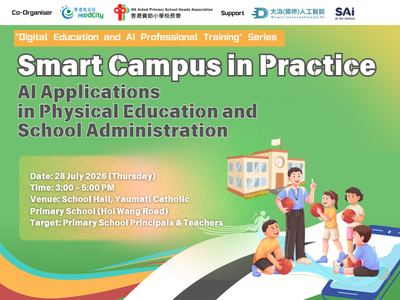
This seminar, themed Practical Implementation of AI in Sports, Cross-curricular Learning and School Administration within Smart Campuses, focuses on the application of artificial intelligence in school physical education, cross-curricular learning, and campus management. It covers areas including technological developments, school-based practices and platform support, presenting a comprehensive model for the implementation of smart campus initiatives.
The seminar will integrate theoretical perspectives with practical experience, illustrating how AI technologies can be applied to enhance students’ physical performance, promote cross-disciplinary learning, optimise teaching processes, and strengthen data utilisation. It will also analyse key planning considerations and implementation strategies, with a view to supporting schools in establishing a sustainable framework for smart campus development.

9 June 2026
This workshop is part of the EdCity Digital Education Teacher Professional Development Series. Through a keynote presentation, a principal’s sharing session, and AI demonstration activities, participants will gain a clearer understanding of the development of AI technology and its applications in schools.
The workshop will outline how artificial intelligence has evolved from early applications to its current ability to support multi-step tasks and decision-making. It will also explain how these technologies are being progressively integrated into everyday school operations, including developments in teaching support, data analysis, and workflow integration. This will help schools develop a more holistic understanding of the role and positioning of AI within education.
1 June 2026

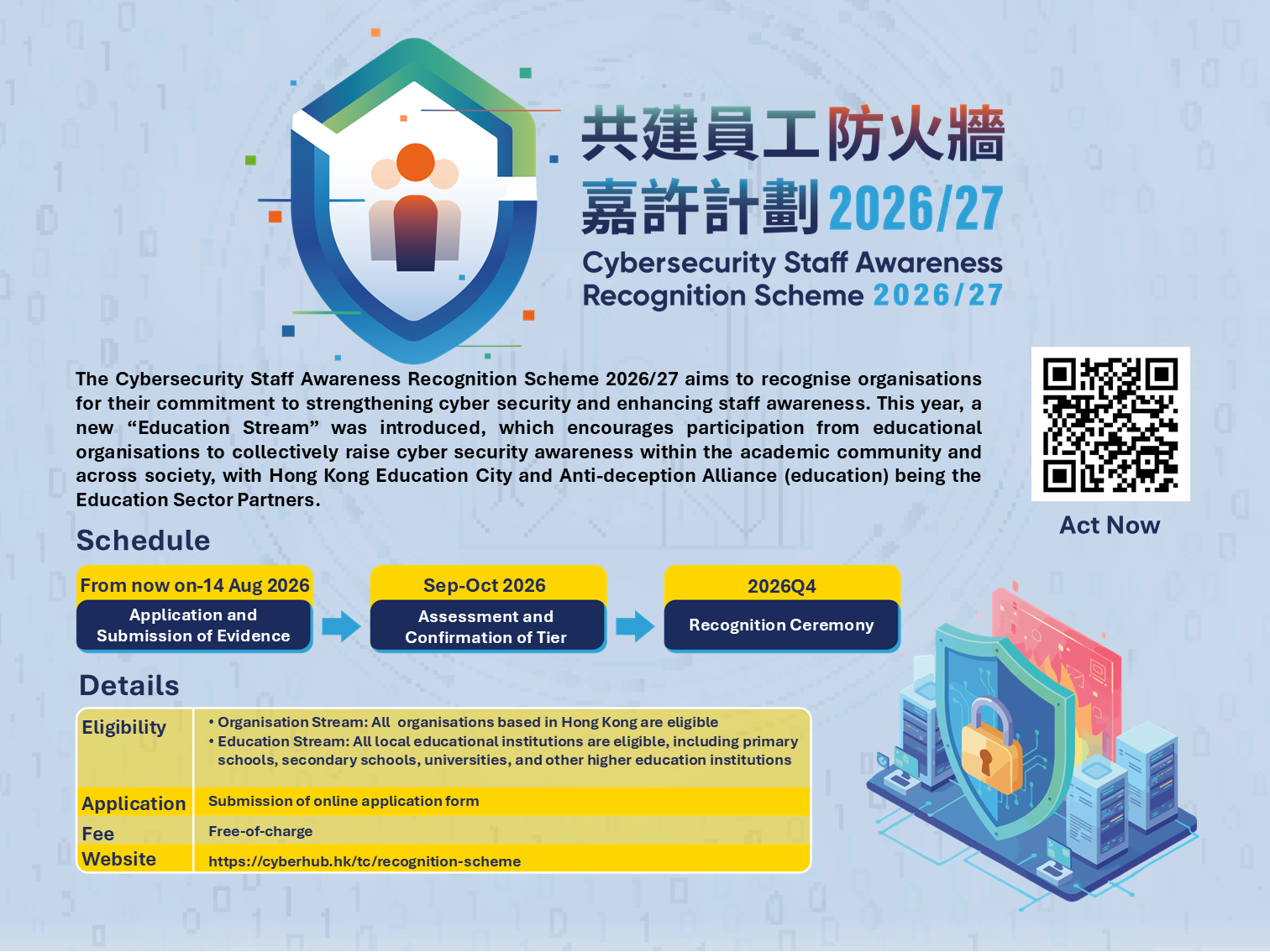
Jointly organised by the Digital Policy Office (DPO), Hong Kong Internet Registration Corporation Limited (HKIRC), and ISACA China Hong Kong Chapter, the “Cybersecurity Staff Awareness Recognition Scheme 2026/27” is now officially open for applications!
To bolster cybersecurity awareness within the academic community, a brand-new “Education Sector” category has been introduced this year, covering primary schools, secondary schools, universities, and other higher education institutions. Fully supporting this initiative, Hong Kong Education City warmly invites all members to actively participate in building a safer digital campus environment together.

28 May 2026
With the rapid development of AI technologies, teachers can use more practical and accessible methods to guide students in understanding the practical applications of IoT, programming, and artificial intelligence. This seminar will use the Smart Farming AIoT Learning Kit as an example to introduce how teachers can guide students to assemble their own smart potted plants. Through micro:bit, students can collect real-time data such as soil moisture, light intensity, temperature, and humidity, enabling them to gradually understand the basic concepts of data collection, sensor applications, and IoT programming through everyday life contexts.
The seminar will also demonstrate how teachers can use a few simple steps on a platform to control the AIoT Learning Kit, and apply an automation platform and AI models to analyse plant growth data. Teachers will learn how to turn processes such as data transmission, automatic generation of growth reports, care recommendations, and automatic watering into classroom tasks that are easy for students to understand and participate in. This will help students connect artificial intelligence, IoT, programming, and scientific inquiry through hands-on practice, building a more interesting cross-curricular learning experience.

22 May 2026
Lesson preparation, marking, teaching material development, and parent communication are all part of teachers’ everyday responsibilities. The Operations Expert from Tencent will introduce the educational applications of Agentic AI and explains how this type of AI, with the capability to plan and execute tasks autonomously, can support teachers in a wide range of teaching and administrative contexts in this seminar.
Unlike conventional AI tools that focus mainly on instant responses, Agentic AI can operate according to teachers’ instructional goals, plan workflows independently, and complete tasks step by step, producing practical teaching materials or documents. Teachers do not need programming knowledge; by simply describing their needs in everyday language, Agentic AI can help share part of the workload related to lesson preparation and administrative tasks.
This seminar is suitable for frontline teachers of all subjects, whether they wish to reduce workload related to lesson preparation and marking, or to adopt a more systematic approach to integrating AI into daily teaching. Curriculum development personnel and ICT coordinators are also welcome to participate and explore the feasibility of school‑based applications together.